Posted on July 22, 2026
Compare plywood and MDF for kitchen cabinets by strength, moisture resistance, finish, maintenance and cost to choose the right material.
Plywood is usually the better material for kitchen cabinet carcasses, under-sink units and shelves because it handles moisture, screws and repeated use better than standard MDF. MDF can still work well for routed or painted shutters in relatively dry areas. In most Indian kitchens, the practical solution is BWP plywood for the cabinet structure and a suitable decorative finish for the visible shutters.
That short answer covers the usual case, but a kitchen is not one uniform environment. The cabinet beside the sink faces a different level of risk from an overhead cabinet. A tall pantry carries a different load from a decorative shutter. Choosing one board for every part of the kitchen may save time during quotation, but it can also create avoidable repairs later.
What is plywood?
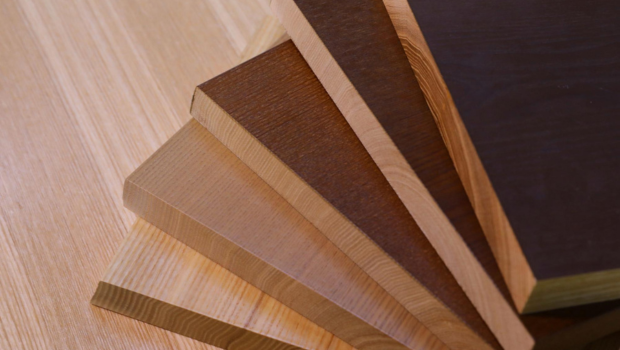
Plywood is an engineered wood panel made by bonding thin wood veneers in alternating grain directions. This cross-layered construction helps the sheet resist splitting and improves dimensional stability. The quality of the veneers, adhesive, pressing process and core construction determines how well the finished board performs.
For kitchens, the grade matters as much as the word plywood. IS 710 BWP plywood is intended for demanding wet or humid applications. IS 303 plywood covers moisture-resistant and boiling-water-resistant categories used in many interior applications. A homeowner should check the grade marking and manufacturer documentation instead of relying on a seller's use of the word "waterproof."
Plywood generally has good screw-holding ability. This matters in a kitchen because hinges, drawer channels, baskets and lift-up fittings repeatedly transfer force to the cabinet material.
What is MDF?
Medium-density fibreboard, or MDF, is made from refined wood fibres bonded with resin and compressed into a smooth, consistent panel. It has no natural grain or veneer layers. Its uniform surface is useful for routed profiles, grooves, paint and certain factory-made shutters.
Standard MDF is vulnerable when water reaches an unsealed edge or fixing hole. Moisture-resistant MDF grades are available, but "moisture resistant" does not automatically mean suitable for continuous water exposure. Product grade, edge sealing and installation quality still decide the outcome.
MDF is also dense and heavy. It provides a smooth finish, yet its screw-holding performance at edges is generally lower than good plywood. Repeated hinge adjustment can become a concern on heavily used shutters if the board or fixing method is unsuitable.
Plywood vs MDF for kitchen cabinets at a glance
|
Factor |
Plywood |
MDF |
|
Construction |
Cross-bonded wood veneers |
Compressed wood fibres and resin |
|
Moisture performance |
Strong when the correct BWP grade is used |
Standard MDF can swell after water enters an edge |
|
Screw holding |
Usually better for hinges and hardware |
Adequate on faces, weaker near edges in demanding use |
|
Load bearing |
Suitable for shelves and cabinet structures |
Can sag if span, thickness or load is poorly planned |
|
Surface finish |
Good base for laminates and veneers |
Very smooth base for paint and routed designs |
|
Weight |
Varies by wood species and construction |
Usually dense and relatively heavy |
|
Repairability |
Hardware can often be repositioned more reliably |
Damaged screw points can be harder to repair |
|
Typical kitchen use |
Carcasses, shelves, sink units, shutters |
Painted or routed shutters in dry zones |
|
Cost |
Quality BWP plywood usually costs more initially |
Standard MDF is often cheaper, but premium grades differ |
Which material handles kitchen moisture better?
BWP plywood is the safer choice for areas exposed to leaks, steam or frequent cleaning. The under-sink cabinet, the unit next to a dishwasher and the cabinet beside a wet utility area need more than a decorative surface. Water can enter through plumbing cut-outs, screw holes, poorly sealed edges or damaged laminate joints.
No wood-based panel should be left in standing water. Even when the plywood bond is designed to resist water, prolonged leakage can stain surfaces, affect hardware and encourage fungal growth in surrounding materials. The purpose of BWP plywood is to reduce the risk of delamination and structural damage while the leak is found and fixed.
Standard MDF is less forgiving. Once its fibres absorb water, the board may swell and lose its original shape. Drying does not reliably restore a swollen edge. For that reason, standard MDF should not be the first choice for sink cabinets or other wet zones.
Which is better for hinges, drawers and hardware?
Plywood is generally better for cabinets that carry repeated mechanical loads. Kitchen shutters may open dozens of times a day. Drawers carry utensils, cookware and provisions. Pull-out baskets place concentrated loads on channels and screws.
Good plywood provides a layered structure into which screws can grip. The benefit is most noticeable at hinge plates, drawer-channel fixings and shelf supports. MDF can hold face-fixed screws when the correct pilot holes and hardware are used, but repeated removal or overtightening can weaken the fixing.
Hardware quality still matters. A strong board cannot compensate for badly aligned hinges, too few fasteners or channels rated below the actual load.
Which material gives a better cabinet finish?
MDF has a naturally smooth, uniform face and clean machinability. It is a common choice for painted shutters, membrane finishes and routed profiles. Designers use it when the door needs grooves or a smooth painted surface.
Plywood works well under decorative laminate, acrylic laminate and veneer. A calibrated plywood panel gives a more consistent thickness, which helps shutters align and reduces visible level differences between adjoining panels. The exposed edges require proper finishing because the veneer layers are visible after cutting.
For a modern flat-panel kitchen, plywood shutters finished with Splice Laminates or Splice Reflect Acrylic can combine a strong core with a clean decorative face. The final choice should account for fingerprint visibility, cleaning habits and the required gloss level.
Where should plywood and MDF be used in a modular kitchen?
This mixed-material approach is often more sensible than declaring one material the winner everywhere. The structural core needs strength and moisture resistance. The visible face needs the desired design and finish.
What thickness works for kitchen cabinets?
Cabinet dimensions, load and hardware determine the correct thickness. Many fabricators use panels around 16 mm or 18 mm for carcasses and shutters, but there is no responsible one-size answer. Long shelves may need greater thickness, intermediate support or a redesigned span. Back panels and drawer bottoms have different requirements.
Ask the kitchen designer to specify the material and thickness for each component in the bill of quantities. A quotation that says only "plywood kitchen" leaves too much room for substitution.
Cost: Which option saves more over time?
Standard MDF often has a lower purchase price than good BWP plywood. Initial sheet price, however, is only one part of the cabinet cost. Hardware, laminate, edge banding, labour and installation may represent a large share of the total. Replacing a swollen sink unit can also disturb the countertop, plumbing and adjoining modules.
Use cost according to risk. Spending more on the wet-zone carcass may be worthwhile even if a less expensive material is used for a dry decorative panel. Ask for a component-wise quotation rather than comparing only the board price per sheet.
Why choose Splice Ply for kitchen cabinets?
Splice Ply has plywood ranges for interior and moisture-prone applications, including IS 710 BWP options such as Splice Seven Star. The company describes its premium plywood in terms of hardwood core construction, calibrated surfaces and quality checks. Those features are relevant to kitchen fabrication because the board must support hardware, stay aligned and accept a clean surface finish.
For the visible cabinet face, the Splice Lam portfolio includes decorative laminates in different colours, patterns and finishes. Splice Reflect Acrylic is positioned for a high-gloss appearance and a non-porous, easy-to-clean surface. This lets the designer select the structural board and decorative face as a coordinated system rather than treating the finish as an afterthought.
Before ordering, confirm the exact Splice product, thickness, IS grade, warranty conditions and recommended application with an authorised dealer. Use the current catalogue rather than assuming that every Splice plywood range has the same specification.
A practical buying checklist
Frequently asked questions
Is plywood better than MDF for kitchen cabinets?
Plywood is generally better for kitchen carcasses, shelves and wet zones because it offers stronger screw holding and, in BWP grade, better resistance to moisture. MDF can be useful for routed or painted shutters in dry areas.
Can MDF be used below a kitchen sink?
Standard MDF is not recommended below a sink. A small plumbing leak can enter cut edges and cause swelling. IS 710 BWP plywood is a more suitable choice for the under-sink structure.
Which plywood grade is best for a modular kitchen?
IS 710 BWP plywood is the preferred choice for sink units and other moisture-prone kitchen cabinets. The appropriate grade for drier overhead units depends on the design, budget and manufacturer specification.
Is plywood suitable for painted kitchen shutters?
Yes, but plywood edges and face preparation require skilled finishing. MDF is often selected for deeply routed paint-grade shutters because its surface is more uniform.
Can laminate make MDF waterproof?
Laminate protects the covered face, but it does not turn standard MDF into a waterproof board. Water can still enter through edges, joints, screw holes and plumbing cut-outs.
Final recommendation
Choose plywood for the parts of a kitchen that carry weight, hold hardware or face moisture. Use MDF selectively where a routed or painted finish is the main requirement and water risk is low. For most Indian modular kitchens, an IS 710 BWP plywood carcass paired with a suitable Splice Lam or Reflect Acrylic finish offers a more dependable balance of strength, appearance and maintenance.
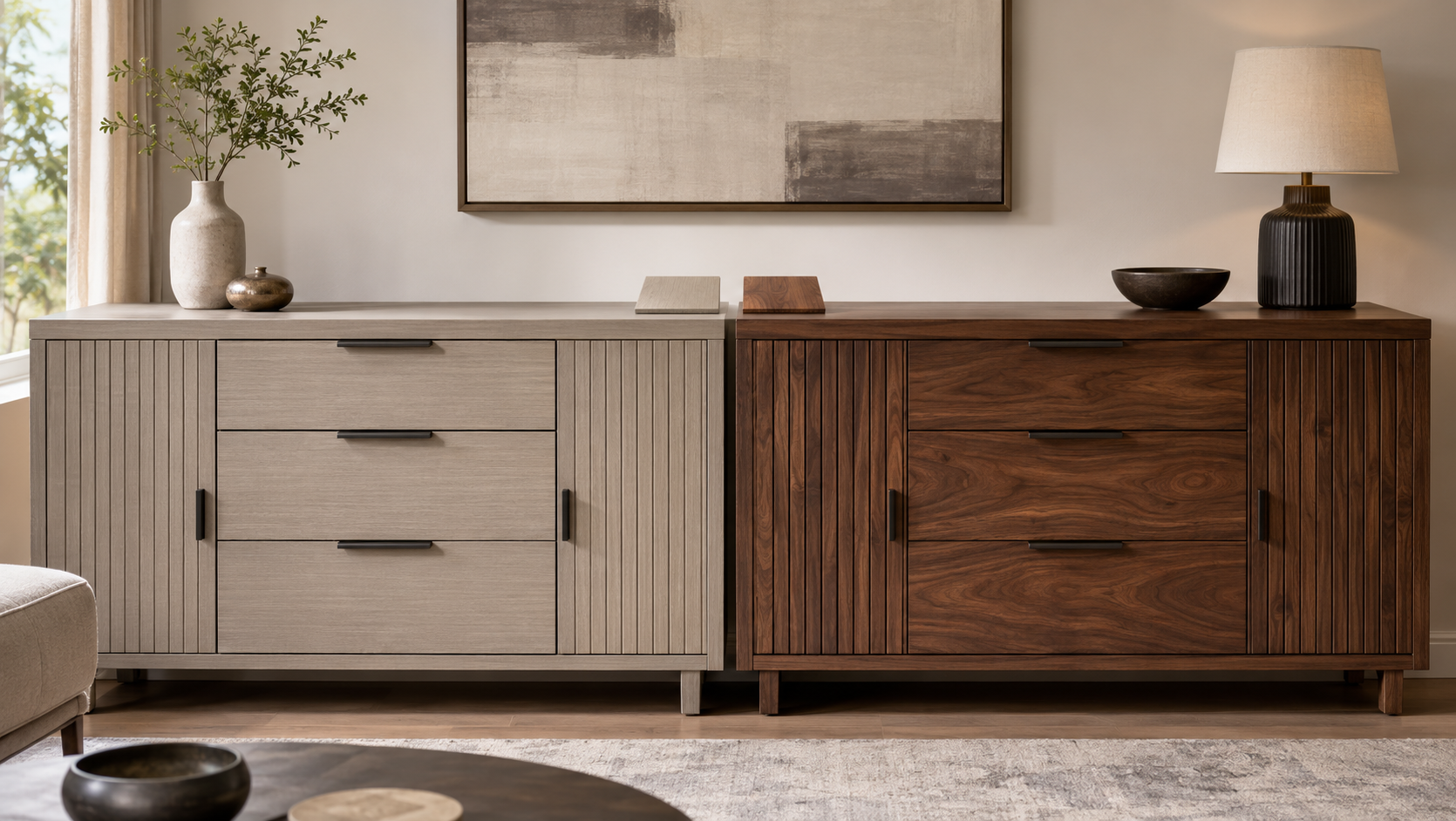 Laminate vs veneer: Which finish is better for furniture?
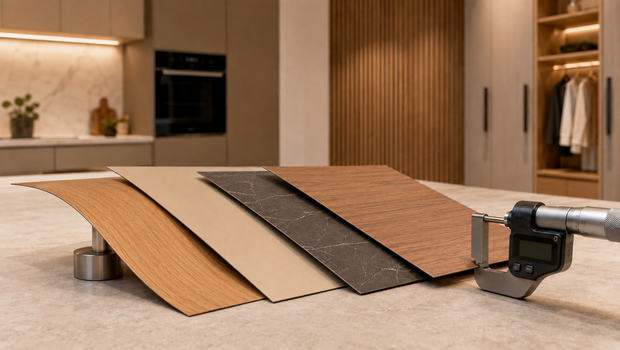 Laminate sheet thickness guide: 0.8 mm, 1 mm and more
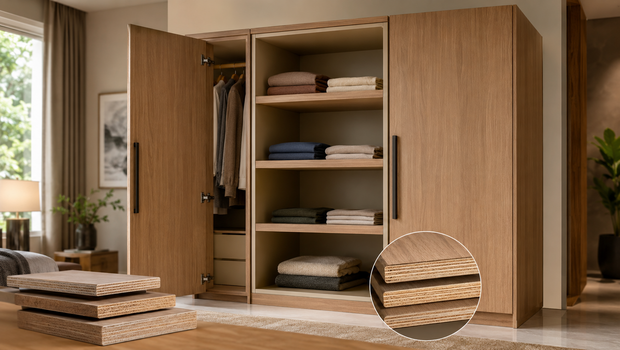 Best plywood thickness for wardrobes, shelves and shutters
 Modern Laminated Doors: Finish, Edge, Core and Maintenance Checklist
.png) Shuttering Plywood Buying Guide: Strength, Reuse, Thickness & Cost Factors
Shuttering Plywood Buying Guide: Strength, Reuse, Thickness & Cost Factors.png) Waterproof Doors for Bathrooms Kitchens & Balconies What Should You Check?
Waterproof Doors for Bathrooms Kitchens & Balconies What Should You Check?.png) Best Laminate Finish for Wardrobes: Matte, Gloss, Texture or Acrylic?
Best Laminate Finish for Wardrobes: Matte, Gloss, Texture or Acrylic? Acrylic Laminate for Kitchen Cabinets: Pros, Cons, Cost & Maintenance
 The Ultimate Guide: Which Plywood is Best for Furniture?
 Splice Ply: The Ultimate Plywood Manufacturer in India for Durable Interiors