Posted on July 22, 2026
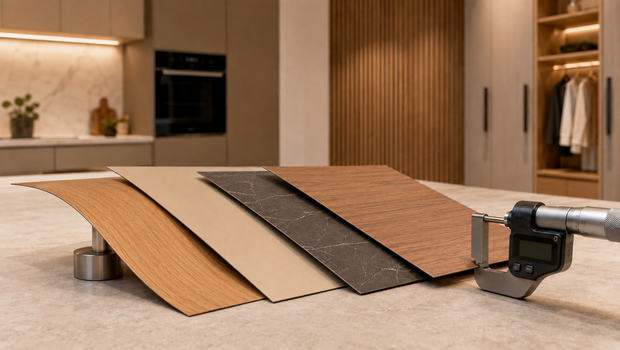
Compare 0.8 mm, 1 mm and thicker laminate sheets by application, durability, bending, finish and cost for furniture and interior projects.
Decorative laminates around 0.8 mm and 1 mm are commonly used on furniture and interior panels. A 0.8 mm sheet can suit wardrobes, wall panels and other vertical surfaces, while 1 mm laminate is often preferred for kitchen shutters, workstations and frequently handled furniture. Thicker compact or specialised laminates serve different structural and high-wear applications.
Thickness affects handling, impact tolerance, edge appearance, bending and price, but it does not define quality by itself. Resin system, surface performance, manufacturing consistency, substrate, adhesive and installation all influence how the finished panel performs.
What does laminate thickness mean?
Decorative laminate is made by pressing layers of kraft paper, decorative paper and a protective surface under controlled heat and pressure. The stated thickness is the thickness of the finished laminate sheet before it is bonded to plywood, MDF or another substrate.
A 1 mm laminate is not a 1 mm furniture panel. It still needs a suitable base board for most cabinet and furniture uses. Compact laminate is different because it has a much thicker kraft core and may be used in applications designed to take advantage of its self-supporting nature.
Always check the actual product data sheet. Nominal thickness, tolerance, finish and sheet size can vary by manufacturer and collection.
0.8 mm vs 1 mm laminate
|
Factor |
0.8 mm laminate |
1 mm laminate |
|
Typical use |
Wardrobes, wall panels, low to moderate-use furniture |
Kitchen shutters, desks, counters and frequently used furniture |
|
Flexibility |
Slightly easier to bend around gentle profiles |
Stiffer and may feel more substantial |
|
Handling |
Requires care to prevent cracking or damage |
Usually more forgiving during fabrication |
|
Edge visibility |
Slimmer edge build-up |
Slightly thicker finished edge |
|
Impact tolerance |
Suitable for many vertical surfaces |
Often preferred where handling and wear are higher |
|
Cost |
Usually lower within the same range |
Usually higher within the same range |
|
Design availability |
Depends on collection |
Depends on collection |
The table describes common market use, not a rule. A well-made 0.8 mm laminate installed on a stable substrate can outperform a poorly bonded 1 mm sheet.
Where does 0.8 mm laminate work well?
Laminate around 0.8 mm is widely used for vertical furniture surfaces where direct impact and abrasion are moderate. Typical uses include wardrobe exteriors, wardrobe interiors, wall panelling, sideboards, bed backs and decorative partitions.
It can also be useful on curved or profiled work when the manufacturer permits bending to the required radius. Heating or forcing a laminate beyond its rated bend can cause cracking, whitening or later separation. The fabricator should follow the technical data for the selected product.
Use extra care during transport and cutting. Thin laminate can chip if unsupported, and damage at the corner may become visible after pressing.
When is 1 mm laminate a better choice?
Laminate around 1 mm is a common choice for surfaces that people touch, clean or bump frequently. Kitchen shutters, office desks, study tables, retail counters and dining furniture are typical examples.
The extra thickness can improve handling during fabrication and may provide better resistance to minor impact compared with a thinner version of the same product. It also creates a slightly stronger visual edge, which may suit flat-panel furniture.
Thickness does not make the joint waterproof. Kitchen applications still need a moisture-appropriate substrate, properly bonded edges and careful detailing around sinks and appliances.
What about laminates thicker than 1 mm?
Thicker decorative or compact laminates are used for specialised applications. These may include toilet partitions, laboratory furniture, lockers, exterior-grade systems or surfaces where the material specification calls for greater impact resistance. Compact laminates can be several millimetres thick and have a solid-coloured or dark kraft core, depending on the product.
Do not substitute a thick laminate for structural plywood without checking the intended application. Fastening, support spacing, edge treatment and hardware differ from conventional laminate-over-plywood construction.
Best laminate thickness by application
Kitchen cabinets
For kitchen shutters, many designers choose 1 mm high-pressure decorative laminate because the surface is handled and cleaned every day. The cabinet core should still be selected for moisture exposure. Under-sink units need careful edge sealing and an appropriate BWP plywood base.
Wardrobes
Both 0.8 mm and 1 mm laminates can work on wardrobe shutters. A 0.8 mm sheet may be sufficient for ordinary vertical use, while 1 mm can suit frequently handled doors or a more substantial edge detail. Balance laminate on both faces according to the panel manufacturer's and fabricator's recommendation to reduce the risk of warping.
Wall panels
Vertical wall panels usually face lower wear than worktops, so 0.8 mm laminate is often adequate. Substrate flatness is critical. Laminate will follow bumps, joints and unevenness in the base.
Desks and study tables
A 1 mm laminate is a sensible starting choice because desks face abrasion from books, laptops and stationery. The front edge needs proper finishing. A laminate face cannot prevent dents caused by a weak or unsupported substrate.
Countertops
Countertops need a product specifically recommended for horizontal high-wear use. Thickness is only one requirement. Check heat resistance, abrasion resistance, impact performance and post-forming capability where relevant.
Does thicker laminate last longer?
Within the same product family, greater thickness can provide more material at the surface and better resistance to handling damage. It does not guarantee a longer life. A thick laminate can still peel if the substrate is damp, the adhesive is wrong or pressing is uneven.
Daily maintenance has an equally practical effect. Abrasive pads can dull a glossy finish. Standing water at an open edge can damage the substrate. Hot cookware can mark a surface that was not designed for direct heat.
Why the substrate matters
Laminate is a surface material. The base board supplies most of the panel's strength, screw holding and dimensional stability. A kitchen shutter made with a suitable laminate over poor or damp plywood can still fail. A perfectly selected plywood sheet can also look bad if the laminate is bonded over dust, an uneven surface or a contaminated adhesive layer.
Use calibrated plywood when alignment and finish consistency matter. The flatter and more uniform the substrate, the easier it is to produce clean shutter gaps and edges.
Why balancing laminate matters
Bonding decorative laminate only to one face can create unequal stresses as adhesive cures and humidity changes. Fabricators often apply a balancing laminate or liner to the reverse face. The two sides do not always need the same decorative design, but they should form a balanced panel system recommended for the construction.
This detail is easy to miss because the reverse side may never be seen after installation. It is still important for wide shutters and panels.
Why choose Splice Laminates?
Splice Lam decorative laminate collections include multiple colours, patterns and finishes for kitchens, wardrobes, wall panels and commercial furniture. The website identifies high-pressure, decorative, digital, matte and glossy options, with common decorative thicknesses around 0.8 mm to 1 mm and customised options subject to requirement.
Collections such as Impresso and Urban Reality give designers a broad surface palette. Splice Reflect Acrylic is a separate premium acrylic-laminate option for mirror-like gloss and a non-porous face. It should be compared by surface system and application, not treated as an ordinary decorative laminate of a different thickness.
Ask for a physical sample before finalising colour and texture. Screen images can change with lighting and display settings. Confirm thickness, surface code, size, care guidance and application suitability from the current catalogue.
Buying and installation checklist
Frequently asked questions
Is 0.8 mm laminate good for wardrobes?
Yes. A good 0.8 mm decorative laminate can suit wardrobe shutters and other vertical surfaces. Use a stable substrate and balance the panel correctly.
Is 1 mm laminate good for kitchens?
One-millimetre high-pressure decorative laminate is commonly used for kitchen shutters and frequently handled surfaces. Check the product's intended application and use a moisture-appropriate base board.
Which is better, 0.8 mm or 1 mm laminate?
Neither is universally better. Choose 0.8 mm for many moderate-use vertical applications and consider 1 mm for surfaces with greater handling or wear. Product quality and installation remain decisive.
Can laminate thickness make furniture waterproof?
No. Laminate protects the covered face, but water can enter through joints, edges and cut-outs. Waterproof performance depends on the complete panel construction.
What laminate thickness is used for wall panels?
Decorative laminate around 0.8 mm is often used for wall panels because they are vertical and face limited abrasion. Confirm fire, substrate and installation requirements for the project.
Final recommendation
Use 0.8 mm laminate where the surface is mainly decorative and vertical. Consider 1 mm for kitchen shutters, desks and furniture that receives more contact. For specialised areas, choose a product designed for that application rather than selecting by thickness alone. Splice Lam samples and current technical information can help the designer match surface, thickness and a suitable Splice plywood substrate to the actual use. Compare other surface options in the guides to different types of laminates and Splice Reflect Acrylic.
 Laminate vs veneer: Which finish is better for furniture?
 Best plywood thickness for wardrobes, shelves and shutters
 Plywood vs MDF for kitchen cabinets: Which is better?
 Modern Laminated Doors: Finish, Edge, Core and Maintenance Checklist
.png) Shuttering Plywood Buying Guide: Strength, Reuse, Thickness & Cost Factors
Shuttering Plywood Buying Guide: Strength, Reuse, Thickness & Cost Factors.png) Waterproof Doors for Bathrooms Kitchens & Balconies What Should You Check?
Waterproof Doors for Bathrooms Kitchens & Balconies What Should You Check?.png) Best Laminate Finish for Wardrobes: Matte, Gloss, Texture or Acrylic?
Best Laminate Finish for Wardrobes: Matte, Gloss, Texture or Acrylic? Acrylic Laminate for Kitchen Cabinets: Pros, Cons, Cost & Maintenance
 The Ultimate Guide: Which Plywood is Best for Furniture?
 Splice Ply: The Ultimate Plywood Manufacturer in India for Durable Interiors