Posted on July 22, 2026
Learn the right plywood thickness for wardrobe carcasses, shelves, shutters, backs and drawers, with practical guidance for lasting furniture.
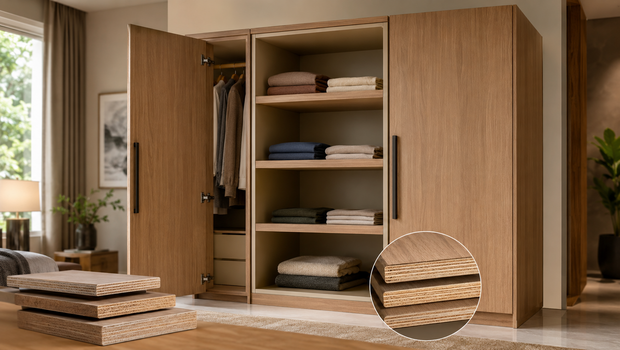
Wardrobe carcasses and shutters commonly use plywood around 16 mm to 19 mm, while backs and drawer bottoms may use thinner panels when the design provides enough support. Shelf thickness depends on the clear span and expected load rather than wardrobe height alone. Tall shutters may need blockboard, framing or specialised hardware to reduce bending.
Those figures are starting points, not a cutting list. A 600 mm shelf holding folded clothes behaves differently from a one-metre shelf loaded with suitcases. A narrow hinged shutter places a different load on hardware from a wide sliding shutter. The right thickness comes from the component's job, its unsupported span and the board specification.
Why wardrobe plywood thickness matters
Thickness affects stiffness, load capacity, screw engagement and overall weight. If a board is too thin, a long shelf can sag and a shutter can twist. If it is unnecessarily thick, the wardrobe becomes heavier and more expensive. Heavy shutters also place greater stress on hinges and sliding systems.
Material quality matters alongside thickness. A thick sheet with core gaps or weak bonding may perform worse than a well-made, calibrated sheet of the correct grade. Designers should therefore specify product, grade and thickness together.
Recommended thickness by wardrobe component
|
Wardrobe component |
Common starting range |
What determines the final choice |
|
Side panels and vertical partitions |
16 to 19 mm |
Wardrobe height, fixing method and hardware |
|
Top and bottom panels |
16 to 19 mm |
Width, support and carcass construction |
|
Regular shelves |
16 to 19 mm |
Clear span and stored weight |
|
Long or heavily loaded shelves |
19 mm or engineered support |
Span, edge reinforcement and centre support |
|
Hinged shutters |
16 to 19 mm |
Shutter height, width, finish and hinge count |
|
Sliding shutters |
System-specific |
Door size, profile system and roller rating |
|
Wardrobe back |
About 6 to 9 mm in many builds |
Groove depth, wall condition and anti-racking role |
|
Drawer sides |
About 12 to 16 mm |
Drawer size and channel system |
|
Drawer bottom |
About 6 to 12 mm |
Drawer width, groove support and load |
These are common fabrication ranges, not mandatory standards. The carpenter, designer and hardware supplier should validate the specification for the actual wardrobe.
Best thickness for wardrobe carcasses
A wardrobe carcass includes the side panels, top, bottom and internal vertical divisions. Panels around 16 mm to 19 mm are common because they provide a practical balance of stiffness and hardware support. A tall unit may need secure anchoring to the wall, especially if the floor is uneven or the shutters are heavy.
Internal divisions do more than organise storage. They shorten shelf spans and help distribute loads. A wide carcass made with thick plywood can still rack or sag if it lacks sensible partitions and a properly fixed back.
Calibrated plywood is useful for modular carcasses. More uniform thickness helps adjoining panels align, keeps shelves level and improves the fit of connectors and edge banding.
Best plywood thickness for shelves
Shelf design should begin with the clear unsupported span. Sag increases as a shelf becomes longer, and the effect is not linear. A small increase in span can produce a noticeable change in deflection. Heavy stacks of clothes, books, luggage or storage boxes add to the problem.
For ordinary wardrobe compartments, 16 mm or 19 mm plywood is often considered depending on span and load. Long shelves may need one or more of the following changes:
Best thickness for hinged shutters
Many hinged wardrobe shutters fall within the 16 mm to 19 mm range, but shutter size and finish change the requirement. Mirrors, thick decorative faces and heavy handles increase weight. Tall doors also amplify small alignment errors.
Hinge quantity and placement should follow the hinge manufacturer's load chart. Adding a random extra hinge does not correct a warped shutter or an unsuitable board. Wide shutters may need to be divided into narrower leaves.
For very tall shutters, quality blockboard can be considered because its batten core is designed for dimensional stability in long panels. Splice manufactures plywood as well as blockboards made with seasoned timber battens and mechanically dried veneers. The final choice should follow the shutter design, finish and hardware system.
Best thickness for sliding wardrobe shutters
Sliding shutters depend on the complete door system. The profile, track, rollers, panel material and finished door weight must work together. Some aluminium-framed systems accept thinner infill panels, while full-board shutters may use thicker panels.
Do not copy a hinged-shutter specification into a sliding wardrobe without checking the system. Excess weight can shorten roller life and make the door difficult to operate. A panel that is too flexible can bow and rub against the adjoining shutter.
Ask the sliding-hardware supplier for the maximum panel dimensions and door weight. Include the laminate, mirror, glass and handle profile when calculating weight.
How thick should the wardrobe back be?
Wardrobe backs are often treated as a surface that merely hides the wall, but a well-fitted back also helps the carcass resist sideways movement. Panels around 6 mm to 9 mm are common in many custom wardrobes. The correct choice depends on whether the back sits in a groove, is screwed to the carcass or is fixed over a frame.
A very thin sheet pinned loosely to the rear offers less structural support. Where the wall has dampness, first repair the source. Increasing back-panel thickness will not solve seepage.
Plywood grade for wardrobes
Bedrooms are usually dry zones, so a good IS 303 grade plywood may suit many wardrobes. BWP plywood may be justified in humid locations, on walls with a known condensation risk or in wardrobes near attached bathrooms. Product selection should account for local conditions instead of using the most expensive grade everywhere.
Termite and borer protection also deserves attention. Check the manufacturer's treatment claims and warranty conditions. Site-level termite control remains necessary because furniture material cannot protect the building or untreated surrounding wood.
Plywood, blockboard or MDF for shutters?
|
Material |
Where it works well |
Main caution |
|
Plywood |
Carcasses, shelves and medium-size shutters |
Exposed edges need finishing; very tall shutters require careful design |
|
Blockboard |
Tall shutters and long vertical panels |
Quality of battens and manufacturing matters |
|
MDF |
Routed or painted decorative shutters |
Weight and moisture sensitivity need consideration |
There is no universal winner. A wardrobe can use plywood for the carcass, blockboard for a tall shutter and a decorative Splice laminate on the visible surfaces.
Why choose Splice Ply for wardrobe construction?
Splice Ply offers plywood ranges for interior furniture along with blockboards and decorative laminates. The brand describes selected plywood products with hardwood cores, calibrated surfaces and grade-specific construction. These attributes matter in wardrobes because shelves need stable support, hinge screws need dependable grip and modular panels need consistent alignment.
Splice blockboards are made from seasoned timber battens placed between mechanically dried veneers and hot pressed. This makes the range worth discussing with the designer for tall shutters or long panels. For surface design, Splice Lam includes woodgrains, solids, patterns, matte and glossy options for bedroom furniture.
Ask an authorised dealer to recommend the current product for the wardrobe's moisture zone and dimensions. Confirm thickness availability, grade, warranty coverage and care instructions before purchase.
Questions to ask your carpenter or designer
Frequently asked questions
Is 12 mm plywood enough for wardrobe shelves?
It may work for short, lightly loaded compartments with suitable support, but it is not a safe universal specification. Shelf span, depth and load must be checked. Many full-size wardrobe shelves use 16 mm or 19 mm panels.
Is 18 mm plywood good for a wardrobe?
Plywood around 18 mm is widely used for wardrobe carcasses, shelves and shutters. The grade, core quality, span and hardware design still determine performance.
Which plywood is best for a bedroom wardrobe?
A good-quality IS 303 plywood may suit a normal dry bedroom. BWP plywood may be selected for humid conditions or locations near wet areas. Verify the grade and application guidance for the exact product.
What is better for tall wardrobe shutters, plywood or blockboard?
Blockboard is often considered for tall shutters because its batten core can provide good dimensional stability. Door dimensions, finish and hardware weight should guide the final choice.
Does thicker plywood prevent shelf sag?
Greater thickness usually increases stiffness, but thickness alone is not enough. Shortening the span, adding a divider and controlling the load can be more effective.
Final recommendation
Start with 16 mm to 19 mm panels for the main wardrobe structure, then adjust each component according to span, load and hardware. Do not use one thickness blindly throughout the wardrobe. A component-wise specification using the appropriate Splice plywood or blockboard, paired with a suitable Splice Lam finish, will produce a better result than a quotation based only on sheet price.
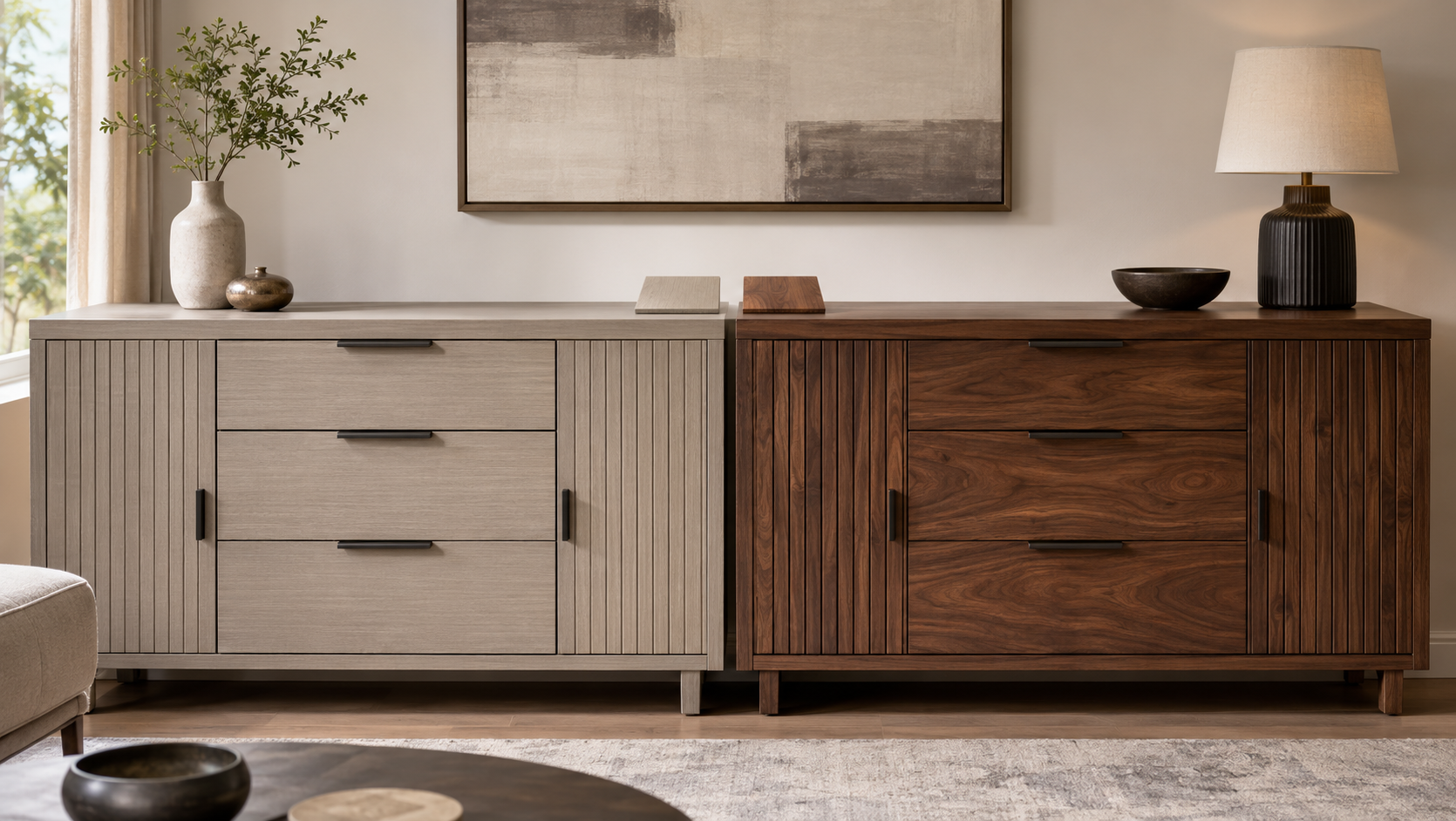 Laminate vs veneer: Which finish is better for furniture?
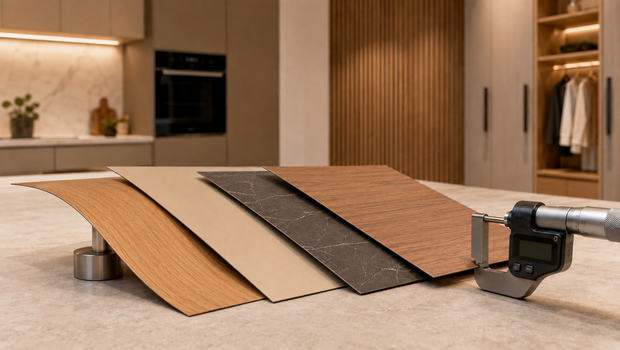 Laminate sheet thickness guide: 0.8 mm, 1 mm and more
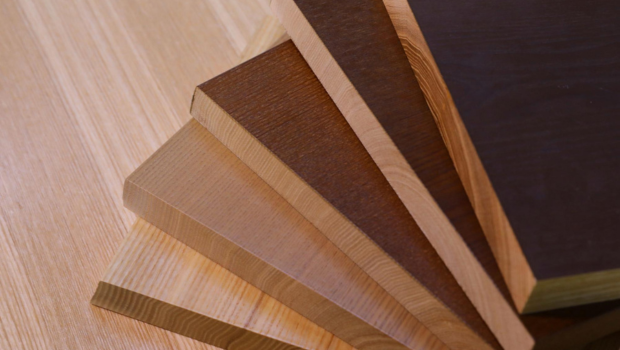 Plywood vs MDF for kitchen cabinets: Which is better?
 Modern Laminated Doors: Finish, Edge, Core and Maintenance Checklist
.png) Shuttering Plywood Buying Guide: Strength, Reuse, Thickness & Cost Factors
Shuttering Plywood Buying Guide: Strength, Reuse, Thickness & Cost Factors.png) Waterproof Doors for Bathrooms Kitchens & Balconies What Should You Check?
Waterproof Doors for Bathrooms Kitchens & Balconies What Should You Check?.png) Best Laminate Finish for Wardrobes: Matte, Gloss, Texture or Acrylic?
Best Laminate Finish for Wardrobes: Matte, Gloss, Texture or Acrylic? Acrylic Laminate for Kitchen Cabinets: Pros, Cons, Cost & Maintenance
 The Ultimate Guide: Which Plywood is Best for Furniture?
 Splice Ply: The Ultimate Plywood Manufacturer in India for Durable Interiors