Posted on September 16, 2026
Laminated flush doors favour flat, repeatable surfaces; membrane doors can wrap profiles and edges more continuously. Room exposure, cleaning, repair and...
If you are researching laminated flush door vs membrane door, start with the application rather than a product label. Laminated flush doors favour flat, repeatable surfaces; membrane doors can wrap profiles and edges more continuously. Room exposure, cleaning, repair and design intent should decide the choice. This guide turns that decision into checks a designer, buyer, workshop and site team can use.
Door performance comes from the complete leaf, frame, hardware and installation. Product names alone do not settle a project requirement. Define the room or production use, expected traffic, moisture exposure, hardware, finish and installation sequence before comparing options. A sample can confirm appearance. Dimensions, process records and technical documents cover the risks a sample cannot show.
For current product options and samples, review the relevant Splice Ply range. Use this article as a project checklist, then confirm technical values against the current product data sheet, approved sample and written advice for the intended application.
|
Quick answer: Laminated flush doors favour flat, repeatable surfaces; membrane doors can wrap profiles and edges more continuously. Room exposure, cleaning, repair and design intent should decide the choice. |
|---|
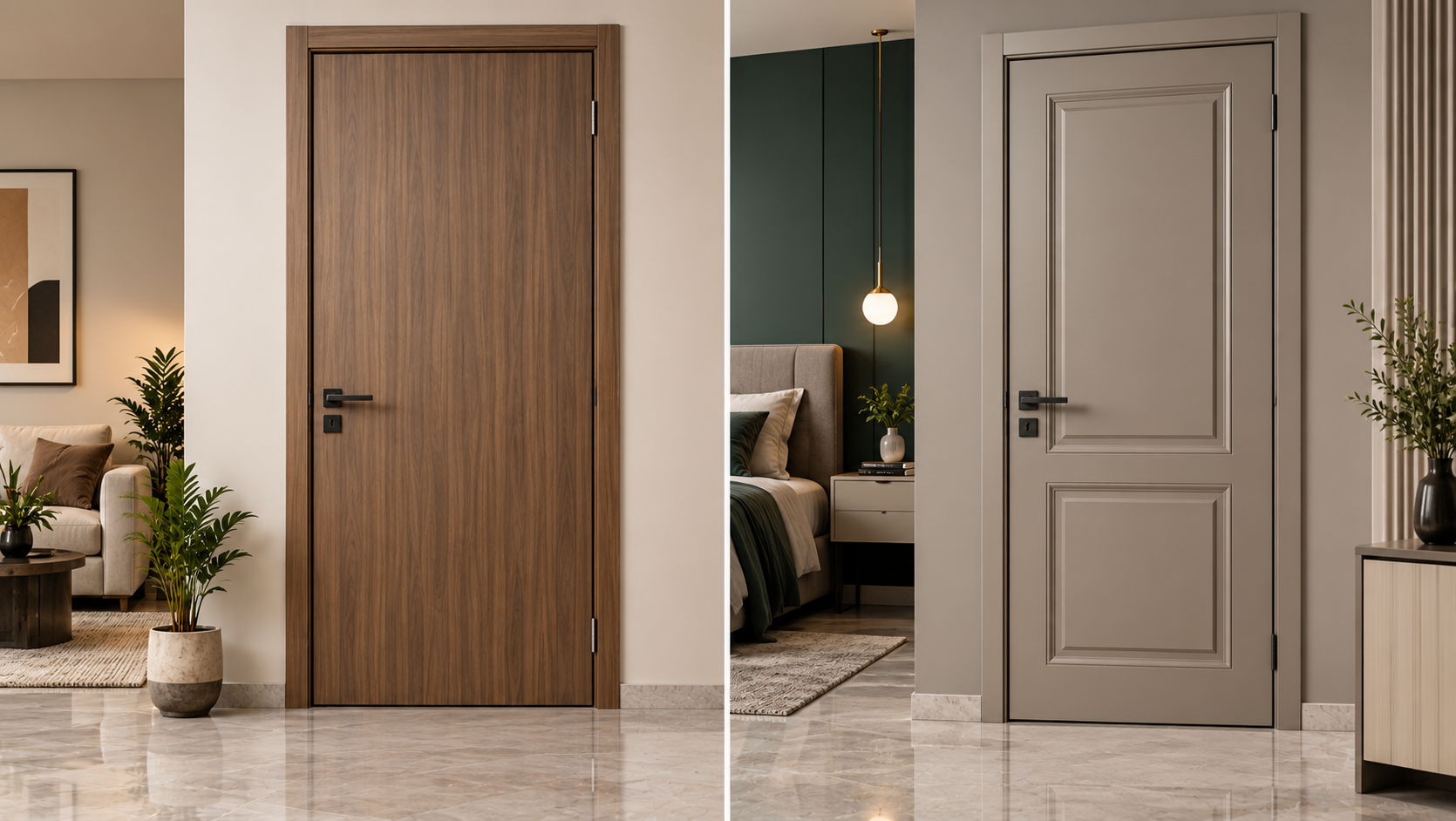
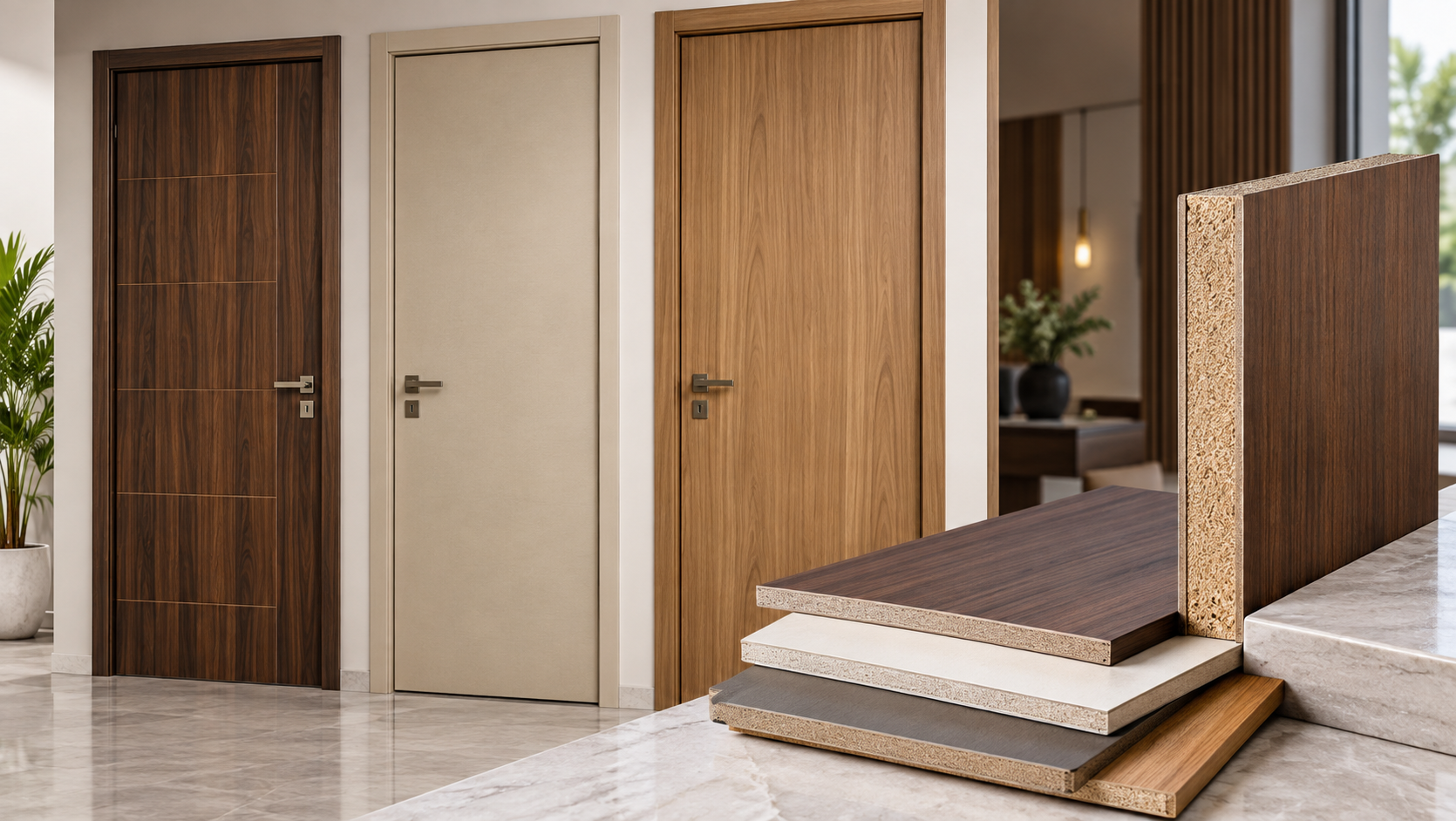
A laminated flush door normally presents a flat decorative face with separately detailed edges. A membrane door uses a flexible film formed over the face and profiles, often wrapping the edge more continuously.
Inspect a full corner, routed detail and hardware cut-out. Those points show the construction difference better than a front photograph. Neither label guarantees water resistance, fire performance or a particular core. Check the complete product description.
Membrane wrapping can follow routed profiles and reduce visible face-to-edge joints. Laminate offers a crisp flat surface and a broad range of textures, but the lipping detail remains visible.
Choose the geometry first. If the design relies on deep grooves or soft profile transitions, test the actual film and radius. Sharp internal corners, weak edge preparation or late routing can expose the substrate in either system.
Wood-based products exchange moisture with the air. Uneven exposure can change dimensions, stress a glue line or move one face more than the other. The cost of getting this wrong usually appears later as rework, delay or an argument over responsibility.
Ask where water or humid air can reach the assembly, check cut edges and junctions, and compare the intended use with the supplier's documented grade and installation guidance. Moisture resistance is not the same as waterproofing. A resistant face cannot compensate for an unsealed edge, wet masonry or standing water.
This decision should be tied to the actual application rather than a product label in isolation.
Write the requirement, inspect a representative sample and record who approves the result before full production or installation. If the team cannot measure or observe the requirement, rewrite it until two inspectors would reach the same conclusion.
Related product information: view the supporting Splice Ply page. Check the live page and current documents before inserting a product-specific dimension, warranty or performance claim into a project specification.
This decision should be tied to the actual application rather than a product label in isolation. This is easiest to settle at sample or mock-up stage, while the team can still change the specification without disrupting finished work.
Write the requirement, inspect a representative sample and record who approves the result before full production or installation. If the team cannot measure or observe the requirement, rewrite it until two inspectors would reach the same conclusion.
The frame controls alignment, clearance and load transfer. A well-made leaf cannot work properly in a twisted or wet frame.
Check plumb, level, square, anchoring and wall junctions before hanging. Confirm the frame depth against the finished wall. Keep the result with the approved sample, batch or opening record. Foam, packing or force should not be used to hide a measurement error that leaves the frame distorted.
This decision should be tied to the actual application rather than a product label in isolation. The cost of getting this wrong usually appears later as rework, delay or an argument over responsibility.
Write the requirement, inspect a representative sample and record who approves the result before full production or installation. If the team cannot measure or observe the requirement, rewrite it until two inspectors would reach the same conclusion.
This decision should be tied to the actual application rather than a product label in isolation.
Write the requirement, inspect a representative sample and record who approves the result before full production or installation. If the team cannot measure or observe the requirement, rewrite it until two inspectors would reach the same conclusion.
Use the table during sample approval, procurement or site inspection. Replace the general wording with project limits where a technical specialist has approved them.
|
Item |
What to verify |
Record |
|---|---|---|
|
How laminated flush and membrane doors differ |
Inspect a full corner, routed detail and hardware cut-out. Those points show the construction difference better than a front photograph. |
Record the result against item or batch 1. |
|
Surface continuity, profiles and edge treatment |
Choose the geometry first. If the design relies on deep grooves or soft profile transitions, test the actual film and radius. |
Record the result against item or batch 2. |
|
Moisture exposure and cleaning |
Where water or humid air can reach the assembly, check cut edges and junctions, and compare the intended use with the supplier's documented grade and installation guidance. |
Record the result against item or batch 3. |
|
Repair, replacement and design repeatability |
The requirement, inspect a representative sample and record who approves the result before full production or installation. |
Record the result against item or batch 4. |
|
Bedrooms and living spaces |
The requirement, inspect a representative sample and record who approves the result before full production or installation. |
Record the result against item or batch 5. |
|
Kitchens and bathroom-adjacent openings |
Plumb, level, square, anchoring and wall junctions before hanging. Confirm the frame depth against the finished wall. |
Record the result against item or batch 6. |
|
Offices, hotels and other repeated-door projects |
The requirement, inspect a representative sample and record who approves the result before full production or installation. |
Record the result against item or batch 7. |
Treat this as an application question. Wood-based products exchange moisture with the air. Uneven exposure can change dimensions, stress a glue line or move one face more than the other. For laminated flush door vs membrane door, ask where water or humid air can reach the assembly, check cut edges and junctions, and compare the intended use with the supplier's documented grade and installation guidance. Moisture resistance is not the same as waterproofing. A resistant face cannot compensate for an unsealed edge, wet masonry or standing water. If the decision affects a tolerance, tested performance or warranty, obtain written confirmation before ordering.
The answer depends on the complete assembly and documented limits. This decision should be tied to the actual application rather than a product label in isolation. For laminated flush door vs membrane door, write the requirement, inspect a representative sample and record who approves the result before full production or installation. If the team cannot measure or observe the requirement, rewrite it until two inspectors would reach the same conclusion. If the decision affects a tolerance, tested performance or warranty, obtain written confirmation before ordering.
Use the project requirement as the starting point. This decision should be tied to the actual application rather than a product label in isolation. For laminated flush door vs membrane door, write the requirement, inspect a representative sample and record who approves the result before full production or installation. If the team cannot measure or observe the requirement, rewrite it until two inspectors would reach the same conclusion. If the decision affects a tolerance, tested performance or warranty, obtain written confirmation before ordering.
There is no reliable one-word answer. This decision should be tied to the actual application rather than a product label in isolation. For laminated flush door vs membrane door, write the requirement, inspect a representative sample and record who approves the result before full production or installation. If the team cannot measure or observe the requirement, rewrite it until two inspectors would reach the same conclusion. If the decision affects a tolerance, tested performance or warranty, obtain written confirmation before ordering.
Where will the product be used, and what conditions will it meet during transport, installation and service?
Which appearance sample, drawing or measurement defines acceptance for laminated flush door vs membrane door?
Which technical statements require a current report or written confirmation from the manufacturer?
Who can stop work when a batch, opening or process does not match the approved requirement?
Define the application and the controlling dimensions.
Shortlist a product using current technical information.
Approve a representative sample or mock-up.
Record batch identity and inspect incoming material.
Protect accepted material through fabrication and installation.
Keep deviations and corrective actions with the project record.
The strongest decision on laminated flush door vs membrane door is one that survives the handover from design to buying, production, installation and maintenance. Keep the approved sample, written requirement, measurements and product identity together. When conditions change, record the change rather than asking the next trade to infer it.
Use the current edition and complete document when checking a specification.
|
Compare door ranges for your application. Contact Splice Ply with the application, dimensions, finish reference and required documentation. |
|---|
 Acrylic vs Laminate: Cost, Finish, Durability and Best Uses
 Modern Laminated Doors: Finish, Edge, Core and Maintenance Checklist
.png) Ply Manufacturer in India: Factory, Testing and Product Quality Checklist
Ply Manufacturer in India: Factory, Testing and Product Quality Checklist Door Manufacturer in India: Questions Architects and Builders Should Ask Before Ordering
.png) Calibrated Plywood Thickness Tolerance for CNC and Modular Furniture
Calibrated Plywood Thickness Tolerance for CNC and Modular Furniture Residential vs Commercial Flush Doors: Performance and Specification Differences
 Laminated Door Sizes and Thickness: A Specification Guide for Indian Projects
 1mm Laminate Sheet Price: What Affects the Cost Before You Buy?
 1mm Laminate Designs for Modern Interiors: Wood, Stone, Matte and High Gloss
 How to Choose 1mm Laminate for Kitchen Cabinets: Finish, Colour and Usage Guide