Posted on October 19, 2026
Build a door schedule that lets you compare Indian manufacturers on construction, dimensions, finish, hardware and delivery rather than slogans.
The search for a top door manufacturer in India often begins with photographs. You see a finish you like and ask for a price. The trouble appears later, when the carpenter discovers that the frame depth, hinge positions, or finished-floor level was never agreed. A good door can become an expensive installation problem if it was selected without a door schedule.
A door schedule is a simple record of every opening and what must fit there. It gives the manufacturer, architect, contractor, and site team one reference. This guide shows how to prepare it and use it to judge suppliers fairly. It applies to ordinary interior doors; a fire-rated or other regulated assembly needs additional project-specific approval and documentation.
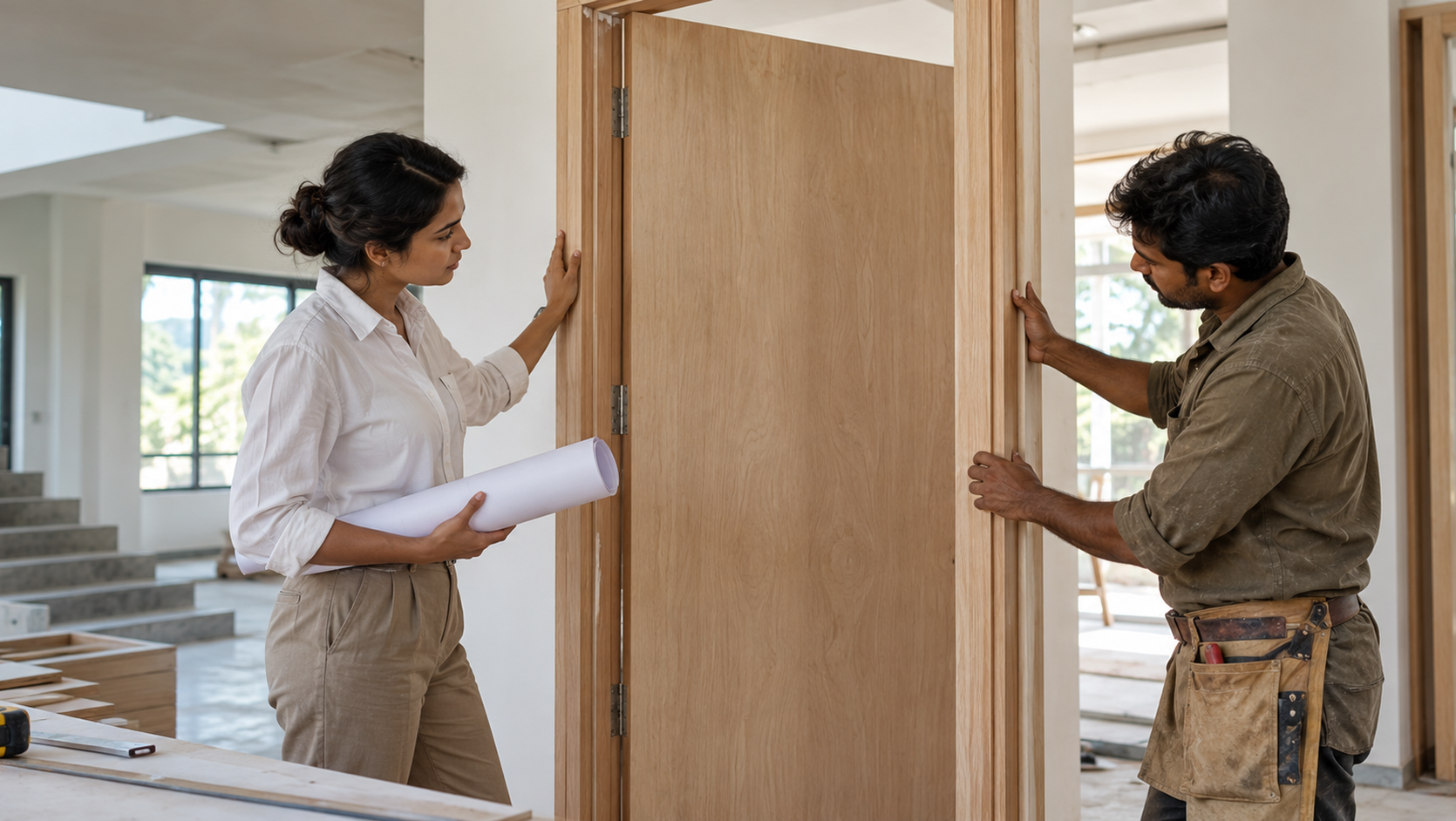
Give each door a number on the floor plan. For each number, record the room, opening width and height at multiple points, wall thickness, intended frame, handing and swing direction. Note the finished floor level on both sides. If tiles or timber flooring have not yet been installed, record the planned build-up and have the contractor confirm it before the door is ordered.
Measure the structural opening separately from the desired clear passage. The door leaf, frame, rebates, stop and installation tolerances all affect the final opening. A supplier who is asked for a “three-foot door” without a drawing may interpret that as a leaf width while the site team meant the masonry gap. That misunderstanding is avoidable if the schedule names each dimension.
Check nearby obstructions. A bedroom door may hit a wardrobe, while a bathroom leaf may block a basin or a corridor route. The preferred swing direction should be agreed before frame fabrication. When access, egress or fire performance matters, the project professional must confirm the applicable requirements rather than relying on a general blog rule.
The leaf is only part of the assembly. The schedule should state frame material and section, hinges, latch or lock, closer if needed, seals, threshold, and finish. A heavy or frequently used door may require a different hardware arrangement from a light bedroom door. Reinforcement at a lock or closer position can also matter; ask the manufacturer what the chosen construction supports.
Splice Ply’s door collection includes flush, membrane, laminated, designer and fire-retardant categories. These are not interchangeable labels. A flush door describes a broad construction and appearance; a membrane or laminate refers to a finishing approach; a fire-retardant product must be considered with its documented assembly and intended rating. Ask for the exact product family and configuration.
If you are comparing decorative options, request an actual sample of the face and edge. A catalogue image cannot show how a routed membrane profile meets a corner or how laminate edges will be finished. Compare the samples in the room’s light. Where multiple doors share a corridor, approve the finish code and grain direction together so they do not look mismatched after installation.
Door production and site construction move on different schedules. A project may order leaves before plaster, flooring and frames are complete. Ask the supplier what measurements they need at order stage, what can still be adjusted later and what changes would require a new leaf. Record the final site survey date and the person who signs it off.
For repeated openings, confirm whether all doors are truly identical. New buildings often contain small dimensional differences. A standard size may be efficient, but forcing it into an opening with the wrong frame or inadequate clearance creates trimming, packing and finishing work. If trimming is permitted at all, the manufacturer’s written instructions should define the limit; do not assume any amount of on-site cutting is harmless.
Check the frame at the same time. Its section must suit the wall, leaf thickness and hardware. A frame that is out of square can make a sound leaf appear warped or cause latches to miss. The Splice Ply door-frame range provides options to discuss, but the order should identify the exact frame profile and dimensions selected for each opening.
One quotation may include a factory-finished leaf, frame, hinges and installation. Another may cover only an unfinished leaf. Put the same fields in front of each supplier: model, core, leaf dimensions, thickness, finish, edge treatment, frame, hardware preparation, quantity, delivery and installation scope. Ask how damage in transport or a measurement error will be handled.
Lead time matters more when the project has several phases. If the chosen finish is special order, ask whether matching replacements will remain available. A hotel corridor or apartment block may need one extra leaf months later. Keep approved samples and product codes so the replacement can be matched as closely as possible.
Do not judge a door only by its initial price. The total cost includes frame adjustment, hardware, finishing, fitting and maintenance. A leaf that needs extensive site correction may cost more in the end than a correctly specified product at a slightly higher factory price.
For a project with many identical doors, approve one complete sample assembly. Check the leaf and frame together, with the planned hinges, lock, closer and seals. Open and close it repeatedly. Look at clearances, latch engagement, finish at the edges and the way it meets the floor. Photograph the approved details and attach the product codes to the schedule.
The sample should represent the order, not an idealised showroom piece made to a different specification. If the manufacturer proposes an alternate core or finish after approval, ask what changes in performance, appearance, maintenance or warranty. Decide before the full batch is fabricated.
Ask each shortlisted manufacturer these practical questions:
1. Which product model fits each opening and room use?
2. What dimensions are factory-controlled, and what site tolerance is assumed?
3. Which frame and hardware combination is recommended for this leaf?
4. Can the finish and edge detail be seen on a representative sample?
5. Who checks the final site dimensions before production?
6. What is included in delivery, installation, and after-sales support?
7. How will a later replacement be matched to the original order?
The answers should be specific enough to enter on the schedule. “Standard door, best quality” is not a specification.
At delivery, check labels, quantities, sizes, finish codes and visible damage before installation. Protect doors from rain and rough storage. Keep the frame and leaf identification together. Once fitted, check opening and closing, latch engagement, clearances and finish before the installer leaves. Record any adjustment still needed.
Give the owner product and care information. A door that sticks after flooring changes or a closer adjustment should be addressed early rather than forced until hardware fails. If the installation is in a school, office or hotel, add the doors to a regular inspection plan appropriate to their use.
Before signing the handover, walk through each doorway with the schedule in hand. A door that opens smoothly when a fitter holds the frame may rub once the architrave and flooring are finished. Test the handle from both sides, check the privacy function where specified, and make sure the leaf can stand at the opening angle the room requires. Write a short snag list with a door number and photograph for each issue. This gives the installer a precise job to return to and prevents a vague complaint about “some doors sticking” from being lost after the site team leaves.
The top door manufacturer for a particular project is the one that can supply a documented, repeatable assembly that fits the building and its schedule. Begin with the openings, approve a real sample, and then compare offers. To explore a Splice option, start with the Splice Ply doors range and ask for the current details of the model that matches your schedule.
 How to Choose a 1 mm Laminate Manufacturer in India for Repeatable Results
 Top 10 Flush Door Manufacturers in India to Put on Your Shortlist
 How to Compare a Laminate Manufacturer and Supplier in India
 How to Choose a Top Plywood Manufacturer in India for a Real Project
 Top 10 Plywood Companies in India to Research Before You Buy
 Acrylic vs Laminate: Cost, Finish, Durability and Best Uses
 Modern Laminated Doors: Finish, Edge, Core and Maintenance Checklist
.png) Ply Manufacturer in India: Factory, Testing and Product Quality Checklist
 Door Manufacturer in India: Questions Architects and Builders Should Ask Before Ordering
.png) Calibrated Plywood Thickness Tolerance for CNC and Modular Furniture